Expanded SAP support choices make retaining ECC more viable – and create room to modernise around a stable core
A recent CIO article1 highlighted a European Commission decision2 that makes SAP’s maintenance and support commitments for on-premises ERP legally binding. In practical terms, the commitments give customers more scope to choose separate support arrangements for different parts of their SAP landscape; SAP cloud offerings are not covered. That matters when an ERP upgrade is already on the table. At first glance, this looks like a licensing and support story. For organisations running deeply embedded SAP ECC 6.0 environments, it is an architecture and investment story.
More choice does not remove the ERP decision; it changes it. For some organisations, retaining SAP ECC 6.0 for longer may now be a more attractive strategic option than before. It creates room to get more value from the ERP investment already made, simplify the core and modernise selected capabilities around it.
The capacity cost of an ERP upgrade
An ERP upgrade can be entirely justified and still cost more than the implementation budget. It draws on experienced people, executive attention, change capacity, technology resources and organisational energy, all of which are finite.
What concerns me is how easily a major ERP programme can begin to dictate the business’s priorities. Customer-facing improvements, operational initiatives, product development and smaller innovation projects may have to wait because the same people and funding are committed to the programme. In a fast-moving technology environment, with AI’s future role in enterprise applications still uncertain, that opportunity cost should form part of the business case.
This is not an argument against SAP S/4HANA, or for postponing an ERP upgrade indefinitely. Retaining ECC for longer creates value only if the time is used deliberately. Organisations should rationalise customisations, improve data quality, simplify processes, reduce technical debt, clarify data and integration ownership, and define their target architecture. That work can support continued modernisation now and make a later move to SAP S/4HANA, another ERP platform or a more modular architecture more manageable.
A clean core is not an empty core
Under SAP’s clean core guidance3, the aim is to stay close to standard processes, manage extensions carefully, govern data and connect other applications through robust integrations. Put simply, the ERP should remain stable, supportable and protected from unnecessary complexity. It means neither removing every function nor keeping every capability inside the ERP. The discipline is deliberate scope.
For an organisation retaining ECC, the ERP can remain the stable transaction backbone while capabilities that need to evolve faster are modernised around it.
McKinsey’s five-tier model of future ERP architecture4 reinforces this distinction. It places a clean core and data foundation at the base, with higher layers for business context, processes, intelligent agents and value measurement. It also cautions that overlays cannot indefinitely compensate for weak data, poor processes or excessive customisation underneath. Modernisation of the core still matters.
Where should physical asset management sit?
This is where you can address the risk of feeling locked into old technology. Selected capabilities can continue to modernise around a stable ERP core where specialist applications can deliver greater operational depth or evolve faster.
SAP S/4HANA provides substantial asset and maintenance management capability. The question is not whether SAP can do enterprise asset management (EAM), but where each responsibility should sit. For some organisations, the ERP’s standard capability will meet the operational need. Others may use specialist EAM software for physical asset strategy, maintenance planning, work execution, reliability information, asset history and field activity. In that architecture, the ERP remains the authoritative platform for financial asset accounting, procurement and enterprise control.
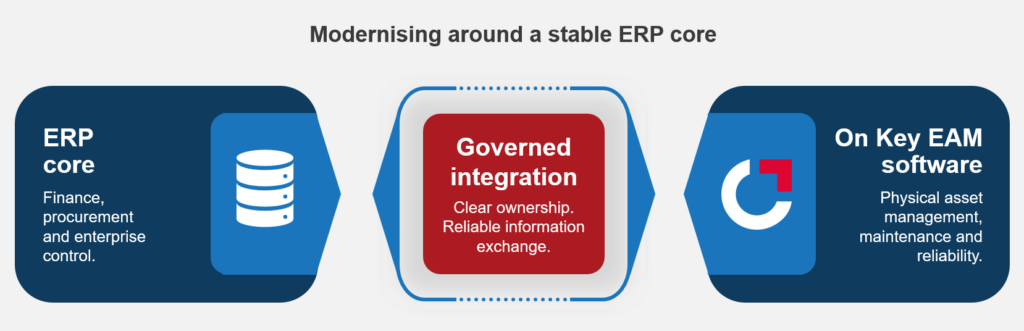
In my experience, maintenance functionality has often been present in customised ECC environments without giving teams the usability, detail or field support they required. That is a practitioner observation, not a universal verdict. Each organisation should decide which platform owns which data, where transaction authority resides, and how information moves without duplication or fragile customisation.
This is where On Key can be considered a way to modernise a specialist capability around the ERP core, rather than an ERP replacement. Its integration approach supports connections with ERP and other enterprise applications, allowing physical asset management improvements to continue without making every operational change dependent on the wider ERP timetable. A maintenance planning and scheduling case study shows this in practice: On Key operated alongside SAP to support maintenance planning and execution.
Our earlier article examined the more direct case for decoupling maintenance from legacy ERP. The strategic question comes first: what belongs in the core, and what is better served around it?
The ERP upgrade may still be necessary and valuable. But expanded support choices mean retaining ECC can now form part of a deliberate modernisation strategy rather than simply delaying the inevitable. The opportunity is to simplify the core, modernise what needs to move faster and keep the business moving forward while preserving the option to make the bigger ERP decision when the time is right.
References
- SAP concedes to EU, freeing CIOs from expensive support shackles – CIO
- Commission accepts binding commitments by SAP to address competition concerns about services for its popular business management software – European Commission
- RISE with SAP: ERP Clean Core Strategy – SAP
- The end of ERP as we know it? Five ways AI is disrupting ERP – McKinsey & Company